Your package will be shipped to our warehouse via FedEx. Before handing your parcel over to FedEx, please make sure to prepare your own packing materials and package the items properly. While the risk of damage or loss during transit is low, it may still occur and could result in financial loss. FedEx does not provide compensation equivalent to the full value of the contents.
Therefore, we strongly recommend that you carefully review this guide to learn how to choose appropriate packaging and protect your items properly, in order to minimize potential risks.
This section covers the following topics:
Shipping Suitcase
Recommended Packaging Materials
| Packaging Type | Recommended | Reason |
| Standard Corrugated Box | ✅ Strongly Recommended | Sturdy, protective, stackable, and compliant with FedEx guidelines |
| Suitcase (esp. soft-sided) | ❌ Not Recommended | Irregular shape, curved edges, limited protection, may incur extra fees |
| Cylindrical, Tubular, or Round Packaging | ❌ Not Recommended | Considered irregular shape and likely to trigger additional surcharges |
| Plastic or Woven Bags | ❌ Not Recommended | Poor protection, prone to damage, may be refused or charged for special handling |
Measure your item’s length, width, and height. Choose a box that will fit your item with cushioning surrounding it on all six sides. If you’re reusing a shipping box, remove all old labels and make sure it’s high quality with no holes, tears, or dents. We recommend purchasing a Medium Moving Box from Home Depot or Lowe's, with a strong preference for the heavy-duty version.
”Please note that FedEx calculates shipping charges based on the greater of the actual weight and the dimensional weight of a package. This means that if a package is large but lightweight, the rated weight will be determined by its dimensions rather than its actual weight. We suggest avoiding oversized packaging to reduce the impact of dimension on shipping charges.“
Long-distance shipping involves multiple handling steps, which can stress your package. Use a strong, high-quality box to protect valuable or fragile items. Once damaged, even compensation may not recover the loss—especially for important or essential belongings.
Packing Your Items
Please complete these steps yourself—do not rely on the pickup staff. Skipping them may increase the risk of issues during transit. If you’re unable to follow these tips, we recommend not shipping your luggage to avoid potential problems.
✅ Packing Tips:
- Even Packing:Pack items evenly to avoid gaps. This minimizes movement and potential damage during transit. Avoid overpacking items, as it may cause the box to bulge or deform.
- Backup Label Inside:Put a copy of the label inside and write shipper and recipient details on the inner package flap. That way, if the label is lost, the package can still be delivered.
- Protect Sharp Edges:Wrap and tape any sharp or protruding edges.
🔴 Fragile and Liquid items:
Fragile or leak-prone items (e.g., glass, plastic, ceramics) may not be insured if damaged. We do not recommend mailing them. If necessary, use sufficient protective packaging.
- Add at least 2-3" of cushioning, such as air cushioning, padded paper, or foam. Make sure the cushioning surrounds the item on all six sides.
- You can also use the box-in-box method for fragile items. Pack the item with 2-3" of cushioning in a box. Then add another 3" of cushioning before you pack it in a second larger box.
- Secure liquids with proper cushioning and waterproof packaging to prevent leaks, which could damage other items if the package is compressed during shipping.
Put at least six strips of shipping tape that is at least 2" wide evenly across all flaps and seams, top and bottom.
Seal your carton using the H-taping method, as recommended by FedEx, to secure all seams. Our staff will reinforce the packaging once it arrives at the warehouse.
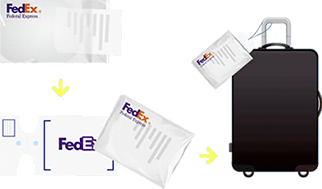
Print and attach the prepaid labels provided by MovingKite.Each label corresponds to one package (e.g., #1) and has a unique tracking number. Do not reuse!
If the package is a box, please add the label to the package’s largest surface. If you’re using a pouch, be sure to reseal it after inserting the shipping label. The label and/or pouch should never be placed over the middle seam or edges of a box. It’s a common mistake that can put a label at risk for damage.
⚠️ If the label is not securely attached and gets separated from the package, your item may be lost and cannot be recovered.
Weight and DIM Limits
Packages that exceed the actual weight or dimension limits can still be shipped, but significant surcharges will apply to FedEx shipping charges.
For U.S. package services, the shipment surcharge rates are determined based on the shipment's zone, as well as the weight and dimensions of each package.
The following information is from page 127 of FedEx’s official 2025 Service Guide. If your package triggers a surcharge condition, consider splitting and repacking to reduce the size or weight of each package.
| Category | Trigger Conditions |
| Dimensions |
- Longest side > 48 inches - Second-longest side > 30 inches - L+Girth ( 2W + 2H) > 105 inches |
| - L + Girth >130 inches
- L >96 inches |
|
|
Unauthorized Package Dimensions: - Length > 108 inches - Length + Girth > 165 inches |
|
| Weight | - Actual weight > 50 lbs |
|
Unauthorized Package Weight: - Actual weight > 150 lbs |
|
| Packaging | Is in non-standard packaging, including any package that: - Not fully enclosed in outer container - Not in corrugated fiberboard (e.g. plastic, metal, wood) - Wrapped in stretch/shrink wrap - Soft pack > 18" (longest side) or > 13" (second-longest) - Round or cylindrical shapes - Has wheels, handles, straps, etc. - Contents not fully inside the package |
*Additional Notes:
Package shape and dimensions may change during transit, which can affect the package’s dimensions and surcharge.
- mceclip0.png6 MB